
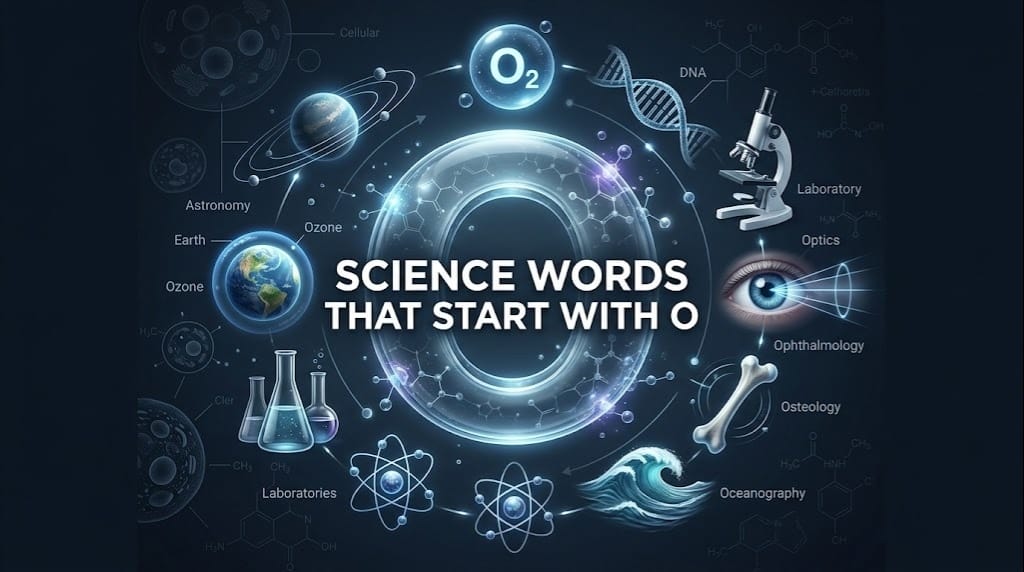
Outstanding Science Words That Start With O: A Complete Exploration of Key Terms and Concepts
From medicine to technology, scientific principles support inventions that shape modern society. It is a combination of many different ideas and understandings. Some science words starting with O give a deep insight of the working of the natural world.
From “optics” to “oxidation,” you should know the vital vocabulary that you can apply in both academic and everyday environments.
List Of Science Words That Start With O
The world of science is rich with terminology that begins with the letter “O,” each word carrying its own importance. For instance, “Osmosis” not only highlights a critical biological process where water moves across a semipermeable membrane but also explains the importance of balance in living organisms.
The exploration of these “O” terms reveals how complex life is and even the most basic concepts hold deep significance.
1. General Science Words
There’s a fascinating list of words that start with the letter ‘O’ that enrich our understanding of the natural world. This is a brief exploration of general scientific terminology beginning with ‘O.’

- Observation:
Observation refers to the act of noticing and recording information through the senses — sight, hearing, touch, taste, and smell. The observer actively interprets and analyzes what they encounter. It serves as the basis of the scientific method and formulation of hypotheses and validation of theories.
- Organism:
An organism is any individual living thing that can grow, reproduce, and respond to stimuli from its environment. This includes a range of living things from the simplest bacteria to complex mammals.
- Oxygen:
In its purest definition, oxygen is a diatomic molecule composed of two oxygen atoms as O₂. Oxygen is a colorless, odorless gas necessary for life on Earth. It is the third most abundant element in the universe and plays a crucial role in processes such as respiration and combustion. It helps humans and animals in cellular respiration, a process that transforms food into energy. As organisms metabolize nutrients, oxygen acts as a powerhouse in releasing energy stored within the food.
- Oxidation:
Oxidation is a process where a substance loses electrons during a chemical reaction. It often involves the addition of oxygen or the removal of hydrogen. It also plays a vital role in rust formation on iron and energy production within our cells. In this sense, oxidation is more than just a chemical change but a fundamental mechanism that sustains life.
- Osmosis:
Osmosis is the movement of water molecules through a semi-permeable membrane. This process occurs when water moves from an area of lower solute concentration to an area of higher solute concentration, effectively balancing the solute levels on either side of the membrane.
It plays a crucial role in maintaining cell turgidity, allowing plants to live and resist wilting. On a larger scale, the principles of osmosis are important in processes like water purification and kidney function in organisms.
- Oscillation:
Oscillation refers to the repetitive back and forth movement around a central point or equilibrium position. This phenomenon can be observed in various systems, such as pendulums or springs compressing and expanding.
- Ozone:
Ozone is a molecule composed of three oxygen atoms (O₃). The ozone layer, located in the Earth’s stratosphere, plays a crucial role in absorbing the sun’s harmful ultraviolet (UV) radiation, thereby protecting living organisms from potential damage. In the upper atmosphere, ozone acts as a shield, while at ground level, it can become a harmful pollutant, contributing to respiratory issues and other health problems.
- Optimum:
Optimum refers to the best or most favorable condition for achieving a desired outcome. This scientific term is often used to show ideal situations for growth, efficiency, or productivity. What is optimal in one scenario may not hold true in another. For instance, the optimum temperature for plant growth is different for every species.
- Orientation:
Orientation refers to the process of understanding one’s position relative to their surroundings, be it in a physical, social, or spatial context. In science, this concept shows how organisms interact with their environment, from the simplest single-celled life to complex human societies. Biological orientation allows animals to locate food, escape predators, or find mates.
- Origin:
Origin refers to the source from which something begins, arises, or is derived. In scientific terms, it can signify the initial state or condition from which an individual or concept evolves. For example, when we explore the origin of life, we delve into theories and experiments that attempt to reveal how simple molecules transformed into complex organisms.
2. Biology Related
Exploring a list of biology-related science terms opens a window into a deeper understanding. By grasping these terms, you elevate your appreciation for the complex processes of life.

- Organelle:
An organelle is a specialized subunit within a cell, playing an important role in its overall function. Each organelle carries out specific tasks that contribute to the cell’s survival and efficiency. The term itself is derived from the scientific term “organ,” highlighting the idea that just as organs work together in a body, organelles collaborate to maintain cellular life.
- Oogenesis:
Oogenesis describes the process of egg cell development in females. This begins in the ovaries, where primordial germ cells turn into primary oocytes before birth. Females are actually born with a limited number of these oocytes, which gradually mature over time.
- Oocyte:
An oocyte, often referred to as an egg cell, is a component of female reproduction. This cell holds half of a female genetic material and is surrounded by fluid-filled follicles that provide essential support during its maturation. Each month, as part of the menstrual cycle, a woman’s ovaries prepare to release a mature oocyte for fertilization with the sperm to form a zygote.
- Ovoviviparous:
This term describes species where embryos develop inside eggs that hatch within the mother’s body. These organisms bridge the gap between egg-laying and live-bearing species. This adaptation is advantageous in environments where external threats to eggs are abundant, offering an extra layer of protection for the developing young.
Specifically, some sharks, such as the hammerhead, and reptiles, like certain species of snakes, exemplify this reproductive mode.
- Ovulation:
Ovulation is a biological process when an ovary releases an egg. This event typically happens around the midpoint of the menstrual cycle, usually about 14 days before menstruation, and it plays an important role in fertility. It can be affected by numerous factors such as stress, diet, and exercise.
- Osmoregulation:
Osmoregulation is the process by which living organisms maintain the balance of water and solutes within their cells and bodies to make sure cellular function remains normal. It regulates internal conditions despite external environmental changes. For example, while fish adapt to the saltiness of their surrounding water, humans manage their hydration levels through mechanisms involving the kidneys and hormones.
- Opsonization:
The term originates from the Greek word “opson,” meaning “to prepare for eating.”
Opsonization is a biological process where pathogens (disease causing agents) are tagged for destruction by immune cells. This process enhances the ability of phagocytes, like macrophages and neutrophils, to recognize and engulf invaders such as bacteria or viruses.
- Ontogeny:
Ontogeny refers to the development of an individual organism from a single cell to its mature form. It includes processes like growth, differentiation, and the formation of complex structures.
- Oxytocin:
Oxytocin, often referred to as the “love hormone,” is a peptide hormone, produced in the hypothalamus and is famous for its influence on social bonding, trust, and maternal behaviors. While its role in childbirth and lactation is well-known, emerging research highlights its broader implications in human relationships.
- Operon:
An operon is a genetic mechanism where a cluster of genes is regulated together in prokaryotes, enabling a coordinated response to environmental changes. This arrangement allows bacteria to conserve energy and resources by activating or silencing the entire set of genes when required, rather than managing each one individually.
Consider the classic example of the lac operon, which governs the breakdown of lactose in E. coli. When lactose is present, the operon activates and facilitates the production of enzymes necessary for its metabolism. Conversely, when lactose is absent, the operon switches off.
- Organogenesis:
Organogenesis refers to the formation of functional organs through cells and tissues during the embryonic period. During this time, which occurs from the 3rd week to the 8th week of gestation, the cells differentiate and migrate to form the heart, brain, limbs, and other essential systems.
3. Anatomy Related
One fascinating aspect of anatomy is the diversity of terminology starting with the letter ‘O.’

- Oesophagus:
The oesophagus is a part of the digestive system, serving as a vital tube that transports ingested food from the throat to the stomach. It is a muscular tube in which food is actively pushed downward via rhythmic contractions known as peristalsis.
- Omentum:
The omentum is a fold of peritoneum extending from the stomach and connecting it to other abdominal organs. It has a complex role in metabolism, immunity, and fat storage. It doesn’t only act as a passive support structure but actively participates in the body’s response to inflammation and infection, almost like a protective shield.
- Occiput:
It refers to the back part of the skull, specifically the region surrounding the occipital bone. The occiput is the base of the cranium and plays a pivotal role in structural support with features such as the foramen magnum, through which the spinal cord connects with the brain.
- Orbit:
The orbit is a complex bony cavity (socket) that contains the eyeball along with soft tissues, nerves, and blood vessels vital for vision. The orbit’s structure consists of seven bones that fuse to create a strong yet flexible framework. Thus, it can also change shape slightly during eye movement to allow a broader vision.
- Oropharynx:
It’s the intermediate part of the throat, situated posterior to the oral cavity and extending from the soft palate to the level of the hyoid bone. Oropharynx is a segment of the pharynx, serving as the gateway between the mouth and the throat, making it essential for both respiration and digestion.
- Osteon:
Osteons, often referred to as Haversian systems, are the fundamental structural units of compact bone. These cylindrical structures are designed to withstand the mechanical stress placed upon bones. An easy definition of an osteon is that it resembles a tiny, tree-like formation, where the central canal serves as the trunk, housing nerves and blood vessels vital for bone health. Surrounding this central canal, concentric layers of bone matrix, known as lamellae, provide stability and resilience.
- Olecranon:
The olecranon is the prominent bony structure at the back of the elbow, easily identifiable as the tip of the ulna. It acts as a lever arm for the triceps muscle, facilitating the extension of the forearm.
- Odontoid:
The odontoid process, also known as the dens, is a bony projection from the second cervical vertebra, C2, that plays a critical role in the cervical spine’s function and stability. It resembles a peg that fits into the atlas, or C1, allowing for pivotal movements of the head. This provides structural support and enables rotations of the skull.
4. Medical Science
Exploring these terms reveals the interconnectedness of various medical fields and highlights the continuous fight for innovation in healthcare.

- Oncology:
Oncology is the branch of medicine that deals with cancer. It includes a mixture of genetics, treatment modalities, and patient care.
- Ophthalmology:
Ophthalmology is the branch of medicine focused on the diagnosis and treatment of eye disorders. This specialty not only involves prescribing glasses and contact lenses but also delves into complex surgical procedures, such as cataract surgery and corneal transplants.
- Otology:
Otology is the branch of medicine focused on the study and treatment of ear disorders that significantly impact hearing and balance. It is the science dedicated to diagnosing, managing, and preventing ear-related ailments – from simple infections to complex issues like hearing loss and tinnitus.
- Orthopedics:
Orthopedics refers to the branch of medicine focused on diagnosing, treating, and preventing disorders related to the musculoskeletal system. This includes bones, joints, ligaments, tendons, and muscles.
- Obstetrics:
Obstetrics is the branch of medicine focused on pregnancy, childbirth, and the postpartum period. Many practitioners now integrate mental health support, nutrition counseling, and community resources into prenatal care to nurture both the body and mind.
- Osteology:
Osteology is the study of bones. It is the science focused on the anatomy and function of bones along with its evolution, health, and behavior.
5. Scientific Studies
Such studies not only broaden our scientific vocabulary but also inspire innovative solutions for pressing global challenges.

- Oceanography:
Oceanography is the scientific study of oceans and their various components. It includes exploration of the ocean’s depths, currents, and life forms. The role of deep-sea currents in regulating global climates and the relationships within coral reefs, which remain critical to ocean health.
- Oenology:
Oenology is the art and science of winemaking. It involves the fermentation process, cultivation of grapes and the conditions that shape the final product.
- Odontology:
Odontology is defined as the study of teeth and their supporting structures.
- Ophiology:
Ophiology is the study of snakes. It is the branch of herpetology dedicated specifically to understanding serpents. This field explores their behavior, physiology, ecology, and even cultural significance.
- Ornithology:
Ornithology is the scientific study of birds. It includes identification of species, their behaviors, complex social structures, and the evolutionary adaptations that shape avian life.
- Optics:
Optics is the branch of physics that delves into the behavior and properties of light. It is the study of how light interacts with various mediums, including lenses, mirrors, and the atmosphere.
- Organology:
Organology is the study of musical instruments. By examining the shades of organology, one can uncover the interconnectedness of sound, culture, and identity. This discipline sheds light on how music not only entertains but also conveys the stories and struggles of communities worldwide.
6. Chemistry Related
A deeper look into these ‘O’ terms highlights the significance of the disciplines of science, encouraging curiosity and further exploration.

- Oxide:
An oxide is defined as a compound that consists of at least one oxygen atom bonded to another element. This includes a vast range of substances, from water (H2O) to more complex metal oxides like iron oxide (Fe2O3).
- Oxalate:
Oxalate refers to the salt or ester derived from oxalic acid, a dicarboxylic acid. Structurally, oxalate is characterized by its two carboxyl groups, making it a powerful chelator that can bind metal ions.
- Organic Chemistry:
Organic chemistry is a dynamic branch of chemistry that delves into the structures, properties, and reactions of carbon-containing compounds. It influences materials science, pharmaceuticals, and environmental chemistry.
- Oxime:
Oximes represent a class of organic compounds that emerge from the interaction between carbonyl compounds, such as aldehydes and ketones, and hydroxylamine. The defining feature of an oxime is the double bond between the nitrogen and the carbon atom, specifically the structure R1R2C=NOH, where R1 and R2 denote the alkyl or aryl groups attached.
- Octane:
Octane is primarily known as a hydrocarbon with the chemical formula C8H18, an alkane. Its significance is in the octane rating system, which measures a fuel’s ability to resist engine knocking during combustion. A higher octane rating indicates better performance in high-compression engines.
- Octanol:
Octanol, a colorless, oily organic compound (fatty alcohol) with the chemical formula C8H18O. This eight-carbon alcohol serves not only as a solvent but also as a key ingredient in the synthesis of numerous chemical compounds and surfactants.
- Olefin:
Olefin refers to a class of hydrocarbons characterized by at least one carbon-carbon double bond (C=C). These compounds, also known as alkenes. They are known as olefins because ethene forms oily liquid when reacted with chlorine.
7. Chemical Elements
| Element | Symbol | Atomic Number | Description |
| Oxygen | O | 8 | A highly reactive nonmetal essential for respiration and combustion. |
| Osmium | Os | 76 | A very dense, hard transition metal in the platinum group. |
| Oganesson | Og | 118 | A synthetic, highly radioactive superheavy element. |
8. Physics Related
In the expansive realm of physics, a fascinating list of terms begins with the letter “O,” each representing important concepts and phenomena.

- Ohm:
Defined as the resistance that allows one volt to push one ampere of current through a circuit. The ohm is a fundamental unit of resistance in physics. It shows the relationship between voltage, current, and resistance in electrical systems.
- Oersted:
The oersted, defined as the unit of magnetic field strength, shows the relationship between electricity and magnetism. Named after the Danish physicist Hans Christian Ørsted, this unit represents the magnetizing force required to induce a magnetic field in a material at a distance of one meter from a current-carrying conductor.
- Oscillator:
An oscillator is a system that experiences periodic motion. It defines a process that can swing back and forth, exhibiting a repeating cycle. These systems include pendulums and spring-mass systems.
- Oscilloscope:
An oscilloscope is an instrument that visually represents electrical signals. It transforms complex waveforms into easy-to-interpret graphs, showcasing voltage changes on one axis and time on the other.
- Orbital:
An orbital is essentially a mathematical function that describes the probability distribution of an electron around a nucleus, shaping our understanding of atomic behavior. Rather than viewing electrons as particles in fixed orbits, this concept embraces the wave-particle duality, allowing us to visualize electron clouds where the likelihood of finding an electron varies. These quantum mechanical orbitals — s, p, d, and f — each possess unique shapes and energy levels
- Opacity:
Opacity refers to the degree to which an object prevents light from passing through it.
- Overtone:
An overtone refers to any frequency that lies above the fundamental frequency of a vibrating object, whether that be a string, a column of air, or any complex system producing sound.
Final Words
In conclusion, our exploration of outstanding science words that start with the letter “O” highlights the diversity of terminology within the scientific community. Engaging with these words not only enhances our vocabulary but also deepens our appreciation for the complexities of nature. You can also discover science words that start with Y. Let us empower our understanding and share our knowledge with others — after all, the language of science is a powerful tool for discovery.
FAQs
Q1. What science words start with O?
A. Observation, organism, oxygen, oxidation, osmosis, and oscillation are common examples.
Q2. What is oxygen?
A. Oxygen is a chemical element essential for respiration and combustion.
Q3. What is osmosis?
A. Osmosis is the movement of water through a semipermeable membrane.
Q4. What is oxidation in science?
A. Oxidation is a chemical process involving the loss of electrons.
Q5. What is an organism?
A. An organism is an individual living thing that can grow, reproduce, and respond to stimuli.
Q6. What is an organelle?
A. An organelle is a specialized structure within a cell.
Q7. What is oncology?
A. Oncology is the branch of medicine concerned with cancer.
Q8. What is oceanography?
A. Oceanography is the scientific study of oceans and their components.
Q9. What are the chemical elements that start with O?
A. Oxygen, osmium, and oganesson are the three elements beginning with O.
Q10. What is optics in science?
A. Optics is the branch of physics that studies light and its behavior.

